



How Much Coffee Grounds for 4 Cups?
The amount of coffee grounds needed for four cups depends on what “one cup” means. A marked coffee-machine cup may hold approximately five or six fluid ounces, while a household mug may hold eight ounces or more.
A practical starting brew ratio is approximately one part coffee to sixteen or seventeen parts water by weight. The ratio can then be adjusted according to roast level, grind size, brewing method, and personal taste.
Calculate the Water Volume First
The following table gives useful starting amounts:
| Four-Cup Definition | Approximate Water Volume | Starting Coffee Amount |
|---|---|---|
| Four 5 oz coffee cups | 590 ml | 35–37 g |
| Four 6 oz coffee cups | 710 ml | 42–44 g |
| Four 8 oz mugs | 950 ml | 56–60 g |
One level tablespoon of ground coffee does not always have the same weight because grind size and roast density vary. A kitchen scale provides more repeatable results than volume measurement.
Adjust the Ratio to Taste
For Stronger Coffee
Increase the coffee amount gradually rather than using a much finer grind.
For example, move from a 1:17 ratio toward 1:15 or 1:16. Making the grind too fine may slow water flow and increase bitterness.
For Milder Coffee
Use slightly less coffee or increase the water volume.
Avoid extending the brewing time excessively, as long contact may extract more bitter compounds even when the final drink still tastes weak.
Match the Grind to the Brewing Method
Different brewing systems need different grind structures.
Drip coffee usually uses a medium grind.
French Press generally uses a coarse grind.
Pour-over methods may use medium-fine to medium grind.
Percolators normally perform better with coarse grounds.
Espresso requires a fine, carefully controlled grind.
The coffee amount and grind should be adjusted together rather than treated as unrelated variables.
Why Freshness Changes the Result
Ground coffee loses aroma more quickly than whole beans because more surface area is exposed to oxygen.
For more consistent brewing, measure the required beans and grind them shortly before use.
Store Beans Away From Heat and Moisture
Coffee should be kept in a dry, dark location away from the stove, window, and sink.
Avoid repeatedly opening a large bag when only a small amount is needed each day.
Using a Coffee Bean Storage Container
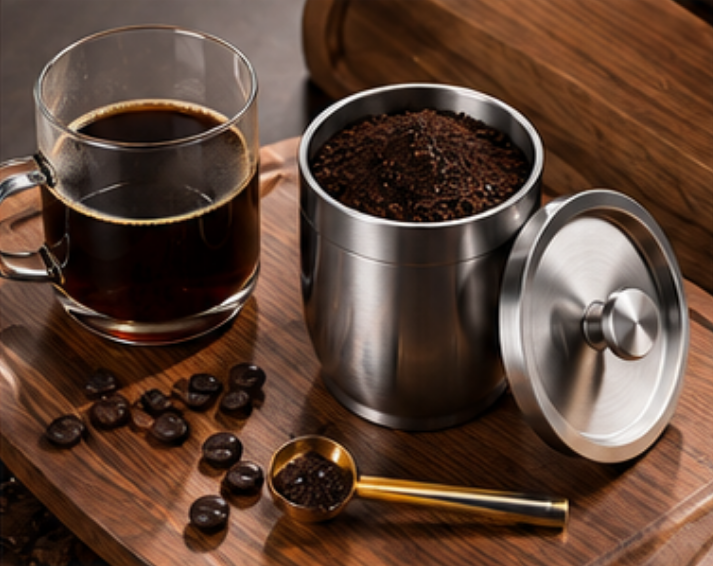
A Coffee Bean Storage Container helps organize beans and limit exposure to air and moisture between brewing sessions.
Our 304 stainless steel Canister is available in several capacities from 800 ml to 2800 ml. Options include a sealing lid, date-recording ring, brushed or mirror finishes, painted colors, customized logos, and retail packaging.
Choose the Correct Capacity
A small household may prefer a compact container that holds one package of beans.
Cafés, offices, and distributors may require larger capacities or coordinated sets for coffee, tea, sugar, and related dry ingredients.
Our Manufacturing and Supply Support
We provide sample, OEM, and ODM services for coffee canisters and other household products.
The container structure, capacity, color, surface finish, logo method, carton design, and packaging can be adjusted according to the buyer’s brand and distribution requirements.
Request coffee storage Samples
Send us your required capacity, sealing structure, surface finish, color, logo, packaging design, and order quantity. We will prepare a Coffee Bean Storage Container recommendation for testing and quotation.