


How Long Will Ice Stay Frozen in An Ice Bucket?
Ice does not remain completely frozen for a fixed number of hours once it is placed inside an Ice Bucket. Melting begins as soon as heat moves from the surrounding air, bucket walls, lid, scoop, and nearby surfaces into the ice.
Under normal indoor conditions, a basic single-wall ice bucket may keep a useful amount of ice for around one to two hours. A prechilled double-wall insulated bucket with a properly fitted lid may keep ice serviceable for roughly three to six hours.
These figures are only practical planning ranges. Actual performance changes according to room temperature, bucket construction, ice quantity, cube size, lid use, and how frequently the bucket is opened.
Why Ice Melts Inside a Bucket
Ice remains frozen only while its temperature stays at or below its melting point. Once heat enters the bucket, the outer surfaces of the cubes begin to melt.
The melting process becomes faster when:
The bucket is placed in direct sunlight
The room is warm
The bucket has a single metal wall
The lid is left open
Only a small amount of ice is added
Meltwater is allowed to surround the cubes
Warm bottles or tools are placed inside
The bucket is repeatedly opened during service
Metal conducts heat efficiently. This is useful in many kitchen tools, but it means a thin, uninsulated metal bucket can transfer surrounding heat to the ice quickly.
How Bucket Construction Changes Ice Retention
Single-Wall Ice Buckets
A single-wall bucket has one layer between the ice and the surrounding environment.
It is usually:
Lightweight
Easy to carry
Simple to clean
Suitable for short serving periods
More economical to produce
However, it normally allows heat to reach the ice more quickly than an insulated design.
Single-wall buckets are better suited to table service where ice will be used within a relatively short period.
Double-Wall Ice Buckets
A double-wall bucket uses an inner and outer wall with a gap between them. This construction slows heat transfer and also reduces condensation on the outside.
A double-wall design can help:
Keep ice usable for longer
Reduce water marks on tables
Improve handling comfort
Maintain a cleaner serving area
Support longer events and bar service
The insulating effect depends on the wall structure, lid design, material thickness, and manufacturing consistency.
Vacuum-Insulated Buckets
Some premium buckets use a vacuum between the inner and outer walls. Because there is less air available to transfer heat, vacuum insulation can provide stronger thermal performance.
These products may be useful for:
Hotels
Premium bars
Long meetings
Outdoor dining
Catering events
High-end gift programs
They are usually more expensive and require greater production control.
Does a Lid Make a Difference?
A lid reduces direct contact between the ice and warm room air. It also limits heat entering from lights, sunlight, and nearby equipment.
A well-fitting lid can:
Slow ice melting
Protect ice from dust
Improve hygiene
Reduce exposure during outdoor service
Prevent the scoop from being left on an unclean surface
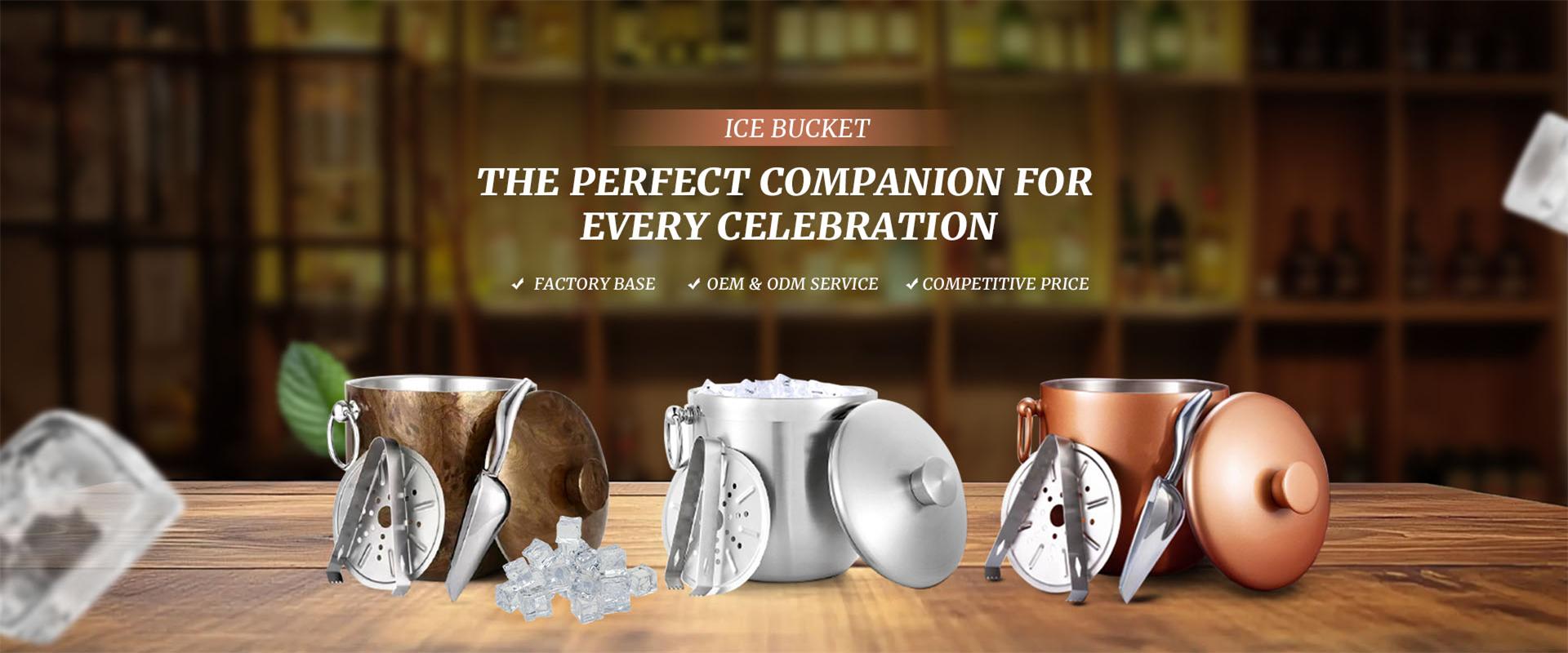
Our ice bucket with lid and scoop uses a double-layer body, a fitted lid, and a dedicated serving scoop for bar, party, and hospitality applications.
The lid should still be easy for staff to remove during busy service. A lid that is difficult to handle may be left open, reducing its practical value.
Ice Size Also Matters
Large cubes usually melt more slowly than crushed ice because they have less surface area exposed relative to their volume.
The general order is:
Large blocks melt most slowly.
Large cubes melt more slowly than small cubes.
Small cubes cool drinks quickly but melt faster.
Crushed ice melts fastest.
A bucket filled with large, solid cubes will normally retain usable ice longer than the same bucket filled with crushed ice.
Cloudy or cracked ice may also melt faster because it has more exposed surfaces and internal weaknesses.
How Much Ice Should Be Added?
A nearly empty bucket loses ice more quickly because warm air fills most of the internal space.
A fuller bucket performs better because the ice mass helps keep the surrounding ice cold.
For practical service:
Fill the bucket close to its intended working capacity
Avoid adding warm bottles directly to serving ice
Refill before only a few cubes remain
Keep reserve ice in a freezer rather than at room temperature
Use separate containers for cooling bottles and serving drink ice
The correct capacity depends on how many drinks will be served and how often staff can refill the bucket.
Should Meltwater Be Removed?
Meltwater remains cold, but it transfers heat to the ice more efficiently than cold air. Ice cubes sitting in water may therefore continue shrinking even when the water feels very cold.
Buckets with a raised grid, insert, or drainage structure can keep part of the ice above the collected water.
For ordinary table service, staff can also:
Drain excess water periodically
Add fresh ice in smaller batches
Avoid mixing fresh ice into large amounts of meltwater
Clean and dry the bucket before refilling
Ways to Make Ice Last Longer
Prechill the Bucket
Place the empty bucket in a refrigerator or fill it temporarily with ice water before service. Remove the water and add fresh ice.
This prevents room-temperature bucket walls from immediately warming the first ice cubes.
Keep It Away From Heat
Do not position the bucket beside:
Ovens
Coffee machines
Dishwashers
Windows with direct sunlight
Heat lamps
Outdoor grills
Warm serving trays
Keep the Lid Closed
Open the bucket only when ice is needed. Return the scoop and close the lid immediately after serving.
Use Dry, Solid Ice
Ice taken directly from a cold freezer usually lasts longer than partially melted ice transported through a warm preparation area.
Select the Right Capacity
An oversized bucket containing only a small amount of ice is less efficient than a properly filled bucket that matches the service requirement.
How Buyers Can Compare Ice Bucket Performance
Do not compare two buckets only by appearance. Test them under the same conditions.
A simple comparison can include:
Prechill both buckets in the same way.
Add the same weight and size of ice.
Place both buckets in the same room.
Keep the lids closed for the same period.
Open each bucket at equal intervals.
Measure the remaining ice and meltwater.
Check outside condensation.
Evaluate lid and scoop convenience.
This provides more useful information than relying only on a claim such as “keeps ice cold for hours.”
Our Ice Bucket Supply Options
We supply an extensive ice bucket range covering compact bar buckets, insulated models, double-wall structures, buckets with lids, outdoor styles, and products developed for party or hotel service.
For wholesale and private-label projects, we can discuss:
Bucket capacity
Single-wall or double-wall construction
Stainless steel finish
Lid structure
Scoop configuration
Handle design
Color
Logo application
Individual packaging
Color-box packaging
OEM and ODM requirements
The appropriate structure should be selected according to the expected service time rather than appearance alone.
Practical Ice Retention Answer
A simple single-wall bucket may keep ice useful for approximately one to two hours indoors. A double-wall insulated model with a lid may support several hours of service when it is properly filled, prechilled, and kept away from heat.
No bucket can stop melting completely. Its function is to slow heat transfer and keep the ice practical for the required serving period.
Request an Ice Bucket Quotation
Send us your required capacity, material, insulation structure, lid design, finish, logo, packaging, and estimated quantity. Our team can recommend a suitable ice bucket for barware, hotel, retail, or catering supply.
Previous: What Is The Best Type Of Ice Bucket?