


How Long Do Ice Cubes Take To Freeze?
Standard ice cubes commonly need about three to four hours to freeze solid in a household freezer operating near -18°C or 0°F. Larger cocktail cubes may need eight to twelve hours, while clear-ice blocks and oversized molds can require 12 to 24 hours.
These times are estimates rather than guarantees. Cube dimensions, water temperature, tray material, freezer performance, airflow, and door-opening frequency can all change the result.
Typical Ice-Freezing Times
| Ice format | Approximate freezing time | Main reason |
|---|---|---|
| Small ice-tray cubes | 2–3 hours | Low water volume and greater surface area |
| Standard household cubes | 3–4 hours | Moderate cavity size |
| Large cocktail cubes | 8–12 hours | Greater distance from surface to center |
| Ice spheres | 8–12 hours or longer | Large volume and reduced exposed surface area |
| Directional clear ice | 12–24 hours | Insulated, gradual freezing process |
| Large block ice | 24 hours or more | High water volume |
The ice may look solid at the surface while remaining liquid or soft in the center. Test one cube rather than assuming the entire tray is ready.
What Controls Freezing Time?
Cube Size
Small cubes freeze faster because cold travels a shorter distance to reach the center. Large cubes take longer but often melt more slowly in a drink because they have less surface area relative to their total volume.
Starting Water Temperature
Warm water must first cool to its freezing point before solidification begins. Hot water does not provide a universal shortcut to faster ice production.
Under some special conditions, warmer water may freeze faster than cooler water, a phenomenon commonly called the Mpemba effect. It is not dependable enough for normal kitchen scheduling because evaporation, convection, container conditions, and freezer behavior vary.
Freezer Temperature
A colder freezer generally removes heat more quickly. However, the appliance should remain within its manufacturer’s recommended operating range.
A freezer that is overloaded, poorly ventilated, repeatedly opened, or experiencing a seal problem may not maintain a stable temperature.
Mold Material
Metal conducts heat efficiently, while thick silicone transfers heat more slowly. Plastic trays vary according to wall thickness and design.
The mold’s external dimensions and cavity spacing also influence how effectively cold air reaches the water.
Freezer Placement
A tray placed level in a cold, well-ventilated area usually freezes more consistently than one pushed tightly between warm food packages.
Do not place an uncovered tray where food or debris can fall into it. Use a compatible cover when available.
How Can You Tell Whether Ice Is Fully Frozen?
The top surface is not a reliable indicator. Remove one cube and inspect its center. Fully frozen ice should remain firm during release rather than bending, collapsing, or leaking water.
Large silicone cubes may look complete around the edges while retaining a liquid center. Waiting overnight is often more reliable when preparing them for an event.
Can Ice Be Made Faster?
Smaller cavities, cold starting water, adequate freezer airflow, and a stable low temperature can reduce waiting time. Preparing multiple trays in advance is more reliable than lowering the freezer temperature excessively before service.
Automatic ice makers can provide repeated batches, but their production rate depends on appliance design, supply-water temperature, ambient conditions, and storage-bin capacity.
After Freezing: Slow Down Melting
Freezing is only the first part of ice management. Once cubes leave the freezer, they absorb heat from the room, serving tools, drinks, and storage container.
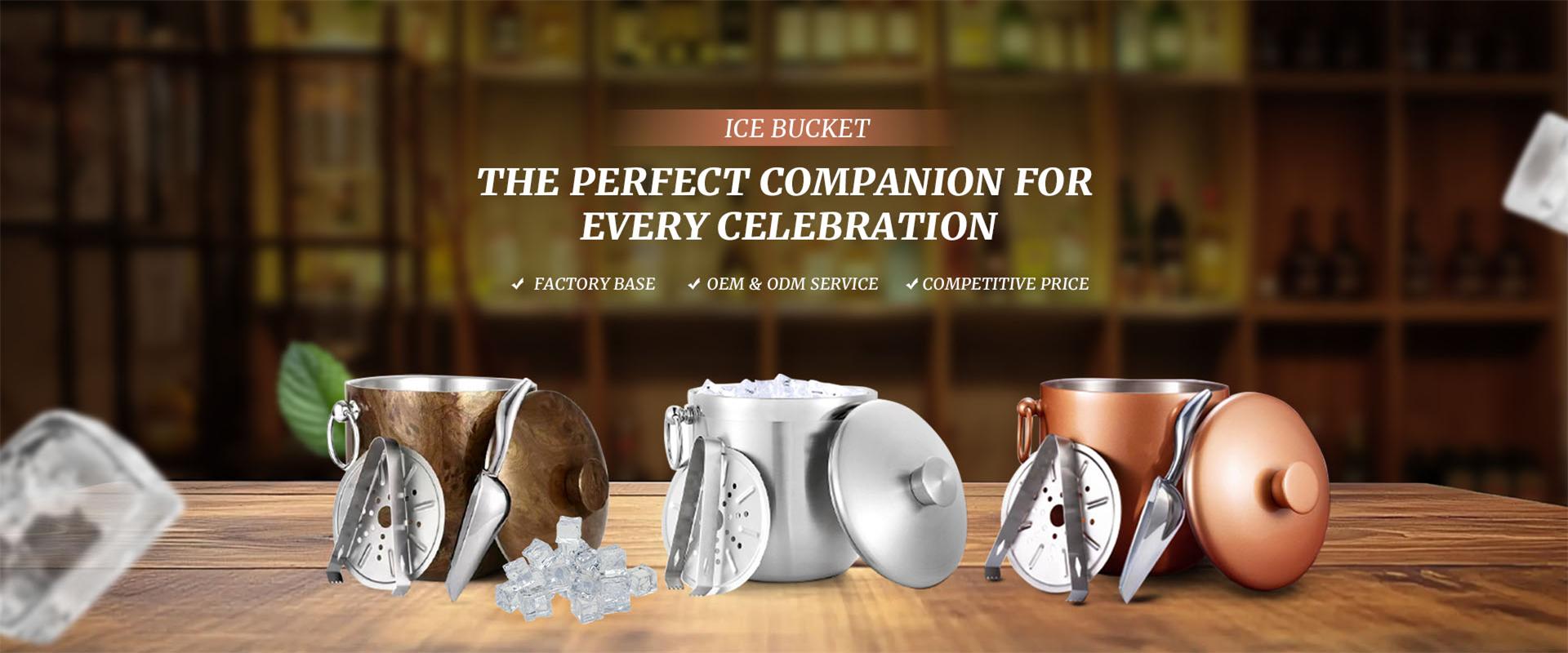
Our factory supplies stainless steel Ice Buckets designed for tabletop, hotel, bar, party, outdoor, and commercial beverage service. We offer models with double-wall or insulated structures, lids, handles, scoops, different capacities, surface finishes, colors, and logo options.
For buyers placing a bulk order of Stainless Steel Insulated Ice Buckets, we support product and packing customization for private-label and distribution programs. Capacity, insulation structure, lid design, accessories, finish, logo, packaging, order volume, and target delivery schedule should be confirmed before production.
View our ice buckets with lids and scoops for different ice-service requirements.
Plan Ice Production Backward
For a party or hospitality shift, calculate the required ice quantity first and begin freezing early. Large cocktail cubes should generally be prepared the previous day, while clear directional ice may require both freezing and cutting time.
Transfer finished cubes into sealed freezer containers to protect them from odors and frost. At the point of service, pre-chill the bucket, close the lid promptly, and handle ice with clean tools.
Freezing time cannot be reduced to one number. Start with the typical range for the cube size, then test the actual mold and freezer before depending on it for a large event.
Previous: How Long Does It Take To Make Ice Cubes?